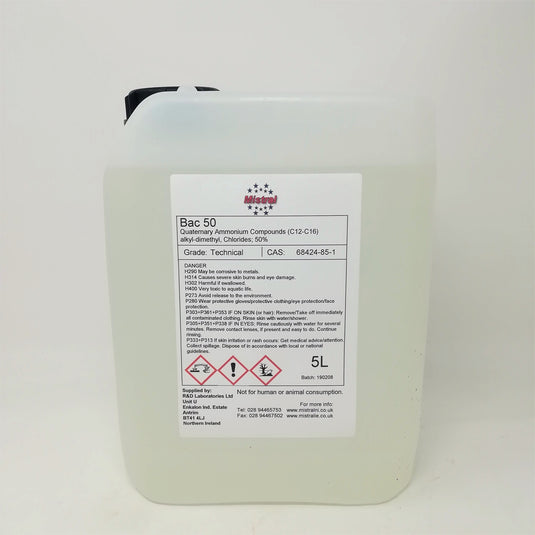
Alkyl Dimethyl Benzyl Ammonium Chloride C10-16
Benzalkonium Chloride - BAC50
Technical grade
BAC50 is an aqueous solution of lauryl dimethyl benzyl ammonium chloride which complies with the U.S.N.F. monograph for benzalkonium chloride solution.
All our prices are fully inclusive of VAT and delivery. There are no additional charges at the Checkout. Available to most parts of Mainland UK, Northern Ireland and Southern Ireland.
Typical properties:
- Chain length distribution: 70% C12 + 30% C14
- Appearance at 25C: Clear liquid
- Colour: Pale yellow
- Density at 20C: 0.98 g/cm3
- Viscosity at 20C: 120 m.Pa.s
- Active matter (mmw 354): 50.0 +/- 1.0
- Free Amine (mmw 221): 0.50% max.
- pH (5% sol): 8.0 +/- 1.0
- composition: 50% active solution in water
- Stability in application: Stable in the presence of light, over the pH range 4 - 10 and up to 120°C
Benzalkonium chloride, also known as alkyl dimethyl benzyl ammonium chloride and ADBAC, is a mixture of alkyl benzyl dimethyl ammonium chlorides of various even-numbered alkyl chain lengths. This product is a nitrogenous cationic surface active agent belonging to the quaternary ammonium group. It has three main categories of use; as a biocide, a cationic surfactant and phase transfer agent in the chemical industry.
Benzalkonium chloride is readily soluble in ethanol, IPA and acetone. Although dissolution in water is slow, aqueous solutions are easier to handle and are preferred. Solutions should be neutral to slightly alkaline, with colour ranging from colourless to a pale yellow. Solutions foam profusely when shaken.
USES FOR ALKYL DIMETHYLBENZYL AMMONIUM CHLORIDE
- As a broad spectrum disinfectant
- Microbe corrosion inhibition in the oil industry
- It is used as a preservative in cosmetics.
- Used in formulations of mild cleaners.
- Used in fungicidal products to kill fungus, mould and algae.
- Used as phase transfer agent.
PLEASE NOTE: It is the responsibility of the user to obtain registration for formulations based on BAC 50 appropriate to its recommended application and the country or territory in which it will be used.
BAC50 is no longer permitted for the use as, or in preparations for the treatment of moss as moss has been reclassified as a plant and comes under the plant protection legislation.
BAC50 is a strongly cationic product and therefore incompatible with formulations containing anionic components. It may, however, be used with other cationic or non-ionic compounds. Users are therefore strongly advised to carry out their compatibility tests prior to initial application.
Biological activity (source: wikipedia.org)
The greatest biocidal activity is associated with the C12-C14 alkyl derivatives. The mechanism of bactericidal/microbicidal action is thought to be due to disruption of intermolecular interactions. This can cause dissociation of cellular membrane lipid bilayers, which compromises cellular permeability controls and induces leakage of cellular contents. Other biomolecular complexes within the bacterial cell can also undergo dissociation. Enzymes, which finely control a wide range of respiratory and metabolic cellular activities, are particularly susceptible to deactivation. Critical intermolecular interactions and tertiary structures in such highly specific biochemical systems can be readily disrupted by cationic surfactants.
Benzalkonium chloride solutions are rapidly acting biocidal agents with a moderately long duration of action. They are active against bacteria and some viruses, fungi, and protozoa. Bacterial spores are considered to be resistant. Solutions are bacteriostatic or bactericidal according to their concentration. Gram-positive bacteria are generally more susceptible than Gram-negative. Activity is not greatly affected by pH, but increases substantially at higher temperatures and prolonged exposure times.
Newer formulations using benzalkonium blended with various quaternary ammonium derivatives can be used to extend the biocidal spectrum and enhance the efficacy of benzalkonium based disinfection products. This technique has been used to improve virucidal activity of quaternary ammonium-based formulations to healthcare infection hazards such as hepatitis, HIV, etc. Quaternary ammonium formulations are now the disinfectants of choice for hospitals. This is on account of user and patient safety even on contact with treated surfaces and the absence of harmful fumes. Benzalkonium solutions for hospital use tend to be neutral to alkaline, non-corrosive on metal surfaces, non-staining and safe to use on all washable surfaces.
The use of appropriate supporting excipients can also greatly improve efficacy and detergency, and prevent deactivation under use conditions. Formulation requires great care as benzalkonium solutions can be readily inactivated in the presence of organic and inorganic contamination. Solutions are incompatible with soaps, and must not be mixed with anionic surfactants. Hard water salts can also reduce biocidal activity. As with any disinfectant, it is recommended that surfaces are free from visible dirt and interfering materials for maximal disinfection performance by quaternary ammonium products.
Although hazardous levels are not likely to be reached under normal use conditions, benzalkonium and other detergents can pose a hazard to marine organisms. Quaternary ammonium disinfectants are effective at very low ppm levels, so excess use should be avoided.
PLEASE NOTE: This product is not for human or animal consumption.
Biocidal Properties
BAC 50 possesses a wide spectrum of antimicrobial efficacy including activity against the following organisms:
Test Micro-organisms:
Bacteria:
Bacillus subtilis
Enterobacter aerogenes
Escherichia coli
Klebsiella pneumoniae
Proteus vulgaris
Pseudomonas aeruginosa
Coriolus versicolor
Epidermophyton floccosum
Gleophylum trabeum
Microsporum canis
Moulds/Yeasts
Alternaria alternata
Aspergillus niger
Aureobasidium pullulans
Candida albicans
Chaetomium globosum
Cladosporium cladosporoides
Coniophora puteana
Penicillium funiculosum
Penicillium glaucum
Poria placenta
Saccharomyces cerevisiae
Trametes versicolor
Trichoderma viride
Trichophyton mentagrophytes
Algae
Chlorella vulgaris
Nostoc commune
Scenedesmus vacuolatus