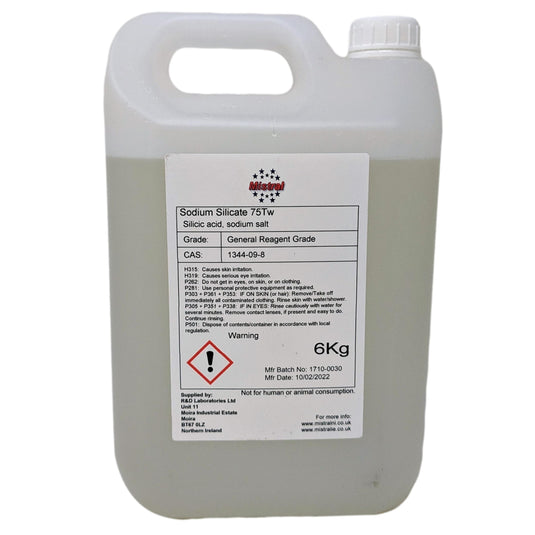
Sodium Silicate Liquid
75°Tw / 36.3% purity
Technical grade
PLEASE NOTE: Due to courier weight restrictions, we have changed the packaging of Sodium Silicate from L to Kg. 4x5L packs will now be supplied as 4x6Kg packs (approx 17.5L)
Sodium silicate is a clear, odourless, viscous liquid. It has a molar ratio of 3.27 and a total solids content of 36.8%. It is produced by fusing sand (SiO2) with sodium carbonate which produces solid glass (cullet). The glass is then dissolved in water and steam under high pressure which produces the sodium silicate solution also known as water glass. It is widely used in industry as sealants, binders, deflocculants, emulsifiers and buffers. It is commonly used to seal concrete and cement
Uses for sodium silicate
Metal repair
Sodium silicate is used, along with magnesium silicate in muffler repair and fitting paste. When dissolved in water, both sodium silicate, and magnesium silicate form a thick paste that is easy to apply. When the exhaust system of an internal combustion engine heats up to its operating temperature, the heat drives out all of the excess water from the paste. The silicate compounds that are left over have glass-like properties, making a somewhat permanent, brittle repair.
Automotive repair
Sodium silicate can be used to seal leaks at the head gasket. Rather than pull the head, a jar of "liquid glass" is poured into the radiator and allowed to circulate. The Water glass is injected via the radiator water into the hotspot at the motor. This technique works because at 93 C the sodium silicate loses water molecules to form a very powerful sealant that will not re-melt below 815 C. This approach is often used by disreputable used-car salespersons to disguise a leaking head gasket.
A sodium silicate repair of a leaking head gasket can hold for up to two years and even longer in some cases. The effect will be almost instant, and steam from the radiator water will stop coming out the exhaust within minutes of application. This repair only works with water to cylinder or water to Air applications and where the sodium silicate reaches the "conversion" temperature of 93 C.
As an Adhesive
Sodium silicate is also used currently as an exhaust system joint and crack sealer for repairing mufflers, resonators, tailpipes and other exhaust components, with and without fiberglass reinforcing tapes. In this application, the sodium silicate (60-70%) is typically mixed with Kaolin (40-30%), an aluminium silicate mineral, in order to make the sodium silicate "glued" joint opaque. The sodium silicate, however, is the high temperature adhesive; the kaolin serves simply as a compatible high temperature colouring agent.
Used to create salt walls, where layers of salt are adhered to a wall. (see below for details).
Cement uses
Sodium silicate has been widely used as a general purpose cement, but especially for applications involving cementing objects exposed to heat or fire. For example, sodium silicate has been provided in home first-aid kits and used in medical practice as a glue for holding human skin together at surface cuts. It has also been used as a general purpose paper cement.
Timber treatment
Sodium silicate is used as a timber treatment to preserve wood from insects and possesses some flame-retardant properties.
Concrete and general masonry Sealer
Concrete treated with a sodium silicate solution helps to significantly reduce porosity in most masonry products such as concrete, stucco, plasters. A chemical reaction occurs with the excess Ca(OH)2 in the concrete that permanently binds the silicates with the surface making them far more wearable and water repellent. Apply a solution of sodium silicate, diluted 1 part silicate with up to 4 parts water by brush or low pressure sprayer. Depending on porosity of concrete etc 2 or 3 applications may be necessary. Please Note that concrete and masonry surfaces may appear darker after treatment.
Refractory use
Water glass is a useful binder of solids, such as vermiculite and perlite. When blended with the aforementioned lightweight aggregates, water glass can be used to make hard, high-temperature insulation boards used for refractories, passive fire protection and high temperature insulations, such as moulded pipe insulation applications. When mixed with finely divided mineral powders, such as vermiculite dust (which is common scrap from the exfoliation process), one can produce high temperature adhesives. The intumescence disappears in the presence of finely divided mineral dust, whereby the waterglass becomes a mere matrix. Water-glass is inexpensive and abundantly available, which makes its use popular in many refractory applications.
Water Treatment
Water glass is used as a water treatment in waste water treatment plants. Water glass will bind to heavier molecules and drag them out of the water.
Magic Crystals
Water glass was used in the magic crystal garden toys from the 1980's. When water glass was combined with a selection of different metals in solution, the waterglass would cause the metals to precipitate. Each metal would precipitate separately causing a different colour stalagmite.
Sodium silicate in the paper & pulp industry
In the peroxide bleaching process of the Pulp and Paper industry sodium silicate functions as a transition metal ion chelate, a pH buffer, a stabiliser, a surface active agent and penetrant and as a corrosion control agent.
Other information from wikipedia:
In industry, the various grades of sodium silicate are characterized by their SiO2:Na2O ratio, which can vary between 2:1 and 3.75:1. Grades with this ratio below 2.85:1 are termed 'alkaline'. Those with a higher SiO2:Na2O ratio are described as 'neutral'.
Anhydrous sodium silicate contains a chain polymeric anion composed of corner shared {SiO4} tetrahedral, and not a discrete SiO32- ion. In addition to the anhydrous form, there are hydrates with the formula Na2SiO3·nH2O (where n = 5, 6, 8, 9) which contain the discrete, approximately tetrahedral anion SiO2(OH)22- with water of hydration. For example, the commercially available sodium silicate pentahydrate Na2SiO3·5H2O is formulated as Na2SiO2(OH)2·4H2O and the nonahydrate Na2SiO3·9H2O is formulated as Na2SiO2(OH)2·8H2O.
Sodium silicate is stable in neutral and alkaline solutions. In acidic solutions, the silicate ion reacts with hydrogen ions to form silicic acid, which when heated and roasted forms silica gel, a hard, glassy substance.
Specification
- Synonyms: Sodium trisilicate solution; Water glass; Silicic acid, sodium salt; sodium hydroxy(oxo)silanolate; acide silicique, sel de sodium; Kieselsaure, Natriumsalz;
- CAS No: 1344-09-8
- EC No: 215-687-4
- Sodium Silicate Formula: Na2Si3O7
- Viscosity: 70-100cPs (20C)
- Density: 1.38 g/cm3 (40 Be)
- pH: approx 11.3
- Solubility: completely miscible in water
Health & safety
Risk phrases: None
Safety phrases: S26 In case of contact with eyes, rinse immediately with plenty of water and seek medical advice. S36/37/39 Wear suitable protective clothing, gloves and eye/face protection.
PLEASE NOTE: This product is not for human or animal consumption.
Click here to view Sales Specification Sheet
Using Sodium Silicate to Adhere Layers of Sea Salt or Rock Salt to Walls
Sodium silicate (water glass) is an effective adhesive and binder due to its alkaline nature and ability to form a hard, glass-like surface when it dries. It can be used to stick sea salt or rock salt layers onto walls, creating a textured or decorative surface. Here’s how you can use it:
Step 1: Prepare the Surface
- Ensure the wall surface is clean, dry, and free from dust or grease.
- If the wall is porous (e.g., drywall, cement, or wood), apply a primer layer of diluted sodium silicate (1:2 ratio with water) to improve adhesion.
- Let the primer dry for about 1-2 hours before applying the main adhesive layer.
- Use commercial sodium silicate solution or dilute solid sodium silicate in water to a paste-like consistency.
- If needed, add a thickening agent (e.g., fumed silica) to improve adhesion and prevent dripping.
- The ideal consistency should be thick but spreadable, similar to syrup.
Step 3: Apply the Adhesive and Salt Layers
Method 1: Direct Application
-
Brush or Roll on Sodium Silicate
- Apply a thick, even layer of sodium silicate onto the wall.
- Use a paintbrush, roller, or trowel, depending on the texture required.
-
Press in the Salt Crystals
- While the sodium silicate is still wet, firmly press layers of sea salt or rock salt onto the surface.
- Work in small sections to ensure even coverage before the adhesive dries.
-
Let it Set
- Allow the adhesive to dry for 12-24 hours.
- The sodium silicate will harden as it absorbs CO₂ from the air, forming a strong bond.
Method 2: Slurry Coating
- Mix sodium silicate with salt grains to form a thick slurry.
- Apply the mixture using a trowel or spatula.
- Smooth or texture as needed before allowing it to dry.
- Optional: Apply a top coat of diluted sodium silicate (1:2 water ratio) to seal the salt layer and prevent flaking.
- To make the surface water-resistant, use a clear acrylic sealer or silicate-based waterproofing coat.