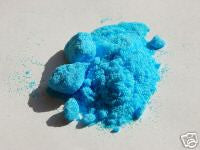
COPPER (II) SULPHATE Pentahydrate
Technical grade 98%
Copper(II) sulphate pentahydrate (CuSO4.5H2O), is a common salt of copper. Copper sulfate is a bright blue, odourless crystalline solid which is soluble in water. The archaic name for copper(II) sulphate is "blue vitriol" or "bluestone". It has numerous applications including as an ingredient in fungicides, algaecides, and pesticides; laboratory analytical reagent,for zinc etching and as a mordant.
Several chemical tests utilize copper sulfate as an indicator. In a flame test its copper ions emit a deep blue-green light. It is used in Fehlings solution and Benedicts solution to test for reducing sugars, which reduce the soluble blue copper(II) sulfate to insoluble red copper oxide. Copper(II) sulfate is also used in the Biuret reagent to test for proteins.
Copper sulphate is a commonly included chemical in children's chemistry sets and is often used in high school crystal growing and copper plating experiments. However due to its toxicity, it is not recommended for small children and should always be supervised.
Copper sulfate is often used to demonstrate an exothermic reaction, in which steel wool or magnesium ribbon is placed in an aqueous solution of CuSO4.
It is used in school chemistry courses to demonstrate the principle of mineral hydration. The pentahydrate form, which is blue, is heated, turning the copper sulfate into the anhydrous form which is white, while the water that was present in the pentahydrate form evaporates. When water is then added to the anhydrous compound, it turns back into the pentahydrate form, regaining its blue colour. It can be used to plate metals with copper.
Before melting Copper(II) Sulfate Pentahydrate gets decomposed. At first it loses two molecules of water at a temperature of 63oC and after that two more at 109oC and finally the last water molecule at 220oC. At a temperature of 650 oC, copper(II) sulphate gets decomposed into copper(II) oxide (CuO) and sulphur trioxide (SO3). Copper sulphate is blue in color due to the presence of water of hydration. If Copper Sulphate is heated in an open flame, the crystals get dehydrated and turn greyish-white
It finds use in agriculture as a fungicide. Mixed with lime it is called Bordeaux mixture, which is used to control fungus on plant leaves, grapes and other berries. Normally it is used as a 1% solution (100g copper sulphate & 100g Lime per 10 litres of water)
Its use as a herbicide is not agricultural, but instead for control of invasive exotic aquatic plants and the roots of other invasive plants near various pipes that contain water.
A very dilute solution of copper sulfate is used to treat aquarium fish of various parasitic infections, and is also used to remove snails from aquariums. However, as the copper ions are also highly toxic to the fish, care must be taken with the dosage. Most species of algae can be controlled with very low concentrations of copper sulfate.
Copper sulphate is found in Moss removal products. It is an effective algaecide and fungicide.
PLEASE NOTE: We do not sell Copper sulphate pentahydrate for use as a Biocidal Product. It is the responsibility of the user to obtain registration for formulations based on Copper Sulphate Pentahydrate, when the intended use is as a biocide, appropriate to its recommended application and the country or territory in which it will be used.
Properties of Copper Sulphate:
- Synonyms: Cupric sulphate; sulphuric acid, Copper salt; Blue vitriol; Bluestone; Sulfate de cuivre; Kupfersulfat Pentahydrat;
- Appearance: blue crystals
- Formula: CuSO4 5H2O
- CAS No: 7758-99-8
- EINECS No: 231-847-6
- Mol weight: 246.48
- Melting point: 150 C
- Density: 2.28 g/cm3
- Solubility: soluble in water 316 g/L (0C) 2033 g/L (100C)
- pH: 4 at 50 g/L
- Refractive index: 1.514
Copper sulphate is soluble in methanol (10.4 g/L @18C) but insoluble in ethanol. At 650C copper sulphate decomposes into copper (II) oxide and sulphur trioxide.
Health & Safety
Risk phrases: R22- Harmful if swallowed. R36/38- Irritating to eyes and skin. R50/53- Very toxic to aquatic organisms, may cause long-term adverse effects in the aquatic environment.
Safety phrases: S22- Do not breathe dust. S60- This material and its container must be disposed of as hazardous waste. S61- Avoid release to the environment.