
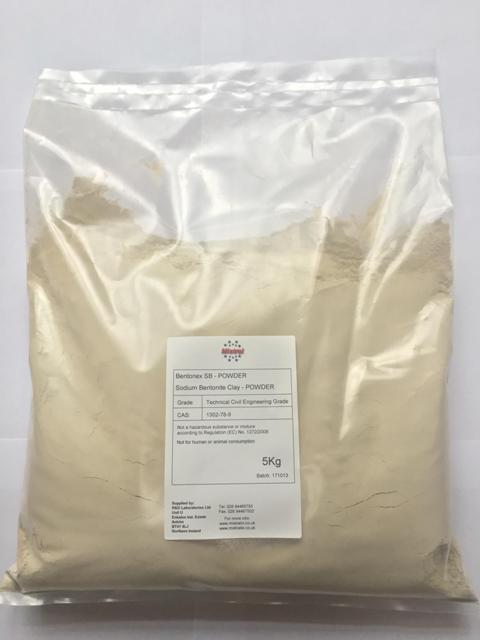
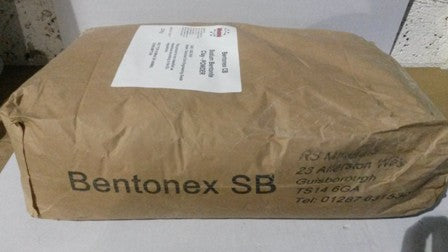

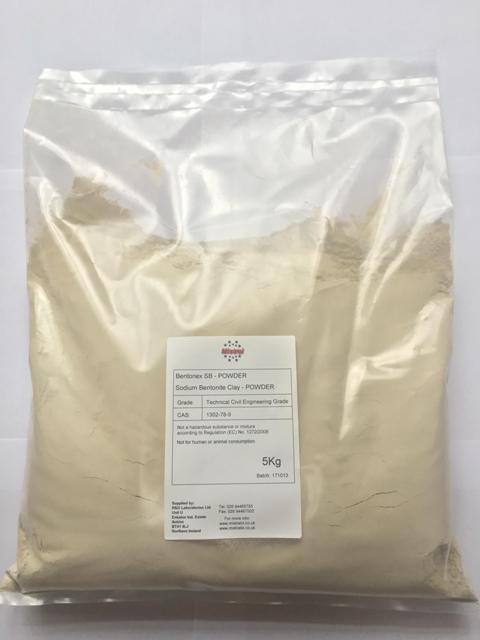
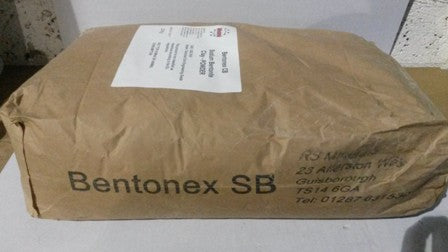
CIVIL ENGINEERING GRADE BENTONITE CLAY
Sodium Bentonite powder
Pond Sealer
Please Note: Prices quoted for Pallets of 20x25Kg and 42x22Kg are only available for delivery to Mainland UK customers. For customers in Ireland and off-shore Islands please contact us for a quotation
Sodium Bentonite is commonly used for sealing ponds, lakes, landfill sites, lagoons etc (see below). It is used in foundries, metallurgy, well drilling slurry, oil, agriculture. Bentonite is also used in chemical industry, environmental protection, zoology construction, ecological construction, building, paper making, textile. Bentonite also can be used in printing & dyeing, pottery and ceramics etc. This clay is Engineering grade and suitable for use in engineering projects.
This grade of Sodium Bentonite is not recommended for cosmetic applications.
properties of Bentonite Clay:
- CAS No: 1302-78-9
- EC No: 215-288-5
- Other names: sodium Bentonite, Montmorillonite, Aluminosilicate of sodium
- Appearance: solid powder
- Colour: Tan
- Odour: mild
- Bulk Density: 800 – 900 Kg/m3
When bentonite is mixed with water, the water molecules will enter between the clay plates, forcing them apart. While the plates are dispersed, the bentonite slurry becomes quite fluid. However, on standing the particles become oriented with the negative surfaces of the plates being attracted to the positive edges. Viscosity increases and a gel is formed – a reversible effect known as thixotropy.
A typical empirical formula for bentonite is:
(Al, Fe0.67 Mg0.33) Si4O10(OH)2Na,Ca0.33
USES FOR BENTONITE:
- Sealing ponds, lakes and landfills (more information below)
- Making Green Sand for sand casting aluminium (used between 5 and 11% mixed with sand and water)
- Well drilling slurry.
- Used as a binding agent in iron ore production.
Bentonite For Sealing Ponds:
Sodium Bentonite clay swells up to eighteen times its dry size when it becomes wet. Expanded bentonite forms an impermeable gel seal which makes an excellent pond sealant. Bentonite is environmentally safe and does not affect the water, livestock, or wildlife. When properly applied, it will not harm fish. For these qualities, bentonite also makes an excellent liner for new pond construction.
There are three basic methods: the Blanket Method, the Mixed Blanket Method and the Sprinkle Method. Bentonite is easily applied. In the case of small ponds, it can be applied with simple hand tools and for larger ponds, with ordinary farm equipment. See below for details of the 3 methods of application.
Application Rates:
- Clay soils: 5-7 Kg/m2
- Sandy Silt: 10-12 Kg/m2
- Silty Sand: 12-15 Kg/m2
- Clean Sand: 15-20 Kg/m2
- Rock or Gravel: 20/25 Kg/m2
THE BLANKET METHOD (Powder or Granules)
The blanket method is considered to be the most effective way to seal a pond or lake and protect against loss through seepage. As it’s name suggests it is a layer of Bentonite POWDER or Bentonite GRANULES (or a mixture of both) which is laid between the base of the pond and a top layer of soil or clay. Application is more labour intensive compared to other methods but the results are superior.
In order to use this method, the pond must be drained. All roots, rocks, logs etc should be removed. Remove a layer of 10 to 15cm of the soil and place around the sides of the pond. The base of the pond should be even and if there are any large crevices or holes these should be filled with a mixture of soil and bentonite (5:1 mix) and tamped down or rolled.
Spread a layer of the Bentonite evenly over the surface. The amount required per square metre will be dependant of the consistency of the substrate. See chart above to determine the quantity required. For larger ponds and lakes it is advisable to divide the area in to smaller manageable areas of around 10 sq m with markers. Lay the required bags per 10 sq m in the marked area.
The soil that was originally excavated needs to be reapplied and spread evenly over the layer of bentonite. Care should be taken to avoid excessive disturbance of the bentonite layer. When all soil has been applied compact the surface by rolling or tamping. Then lightly spray the surface with water and tamp down a second time. When refilling pond, ensure water flow is slow and even to avoid any disturbance of the newly prepared surface. It will take about a week for the bentonite layer to achieve maximum saturation and offer optimum protection against seepage.
THE MIXED BLANKET METHOD (Powder or Granules)
The Mixed Blanket Method of applying Bentonite is similar to that of the Blanket Method. It involves mixing Bentonite POWDER or Bentonite GRANULES (or a mixture of both) with soil and laying on top of the base of the pond or lake.
In order to use this method, the pond must be drained. All roots, rocks, logs etc should be removed. The base of the pond should be even and if there are any large crevices or holes these should be filled with a mixture of soil and bentonite (5:1 mix) and tamped down or rolled.
Next, plough, till or disc the base of the pond ensuring a thorough mix of the substrate so that there is an even distribution of the soil. The depth of the plough etc should be set to between 10 and 20cm. After ploughing the surface rake or drag the soil to create a smooth, even surface
Next, spread a layer of the Bentonite evenly over the surface. The amount required per square metre will be dependant of the consistency of the substrate. See chart above to determine the quantity required. For larger ponds and lakes it is advisable to divide the area in to smaller manageable areas of around 10 sq m with markers. Lay the required bags per 10 sq m in the marked area. Using the same depth setting as on the initial turning of the soil, plough, till or disc the surface to mix the bentonite with the soil. Once satisfied that the bentonite and soil are well mixed compact the surface by rolling or tamping. Then lightly spray the surface with water and tamp down a second time. When refilling pond, ensure water flow is slow and even to avoid any disturbance of the newly prepared surface. It will take about a week for the bentonite layer to achieve maximum saturation and offer optimum protection against seepage
THE SPRINKLE METHOD (Granules or Pellets)
The Sprinkle Method is used where it is not possible to drain the pond or lake. It is considered to be less effective at sealing ponds and reducing seepage compared to the Blanket and Mixed Blanket methods. It is commonly employed for targeted treatment of areas where seepage is suspected to be occurring, rather than treating the complete bed of the pond or lake. The Powdered Bentonite is not recommended for this Method. The GRANULAR Bentonite should be used for this application and for very deep water, the Bentonite PELLETS are preferred. Usage of granules is considered to be safe for fish and wildlife.
See chart above to determine the quantity required per square metre of area being treated. Pour the granules over the surface of the water. The granules will drop down to the bottom of the pond and be drawn into any crevices, holes and cracks. There, they will swell and seal the crevices etc.
BENTONITE FOR NEW POND & LAKE CONSTRUCTION:
• Since bentonite powder is a dusty and highly absorbent mineral, we suggest carrying out the work on a calm and dry day. The use of goggles, dust mask, and gloves is recommended.
• Remove any large lumps and stones from the soil, which needs to be sufficiently dry to mix easily with the bentonite powder.
• In the case of very porous soils (such as those with a high content of stone, limestone, chalk or peat) we suggest using a bentonite enriched sand layer. Suitable fine sand for mixing is readily available from builders’ merchants.
• To achieve a good seal, the bentonite powder must be thoroughly mixed with the soil or sand.
• Mixing can be carried out by use of a cement mixer. Add the soil or sand first, followed by the bentonite.
• For sandy soils, porous soils and bentonite enriched sands we suggest using 10 Kg of bentonite per square metre. For clayey soils, as little as 4 kg per square metre may be adequate.
• The bulk density of bentonite powder is around 850 Kg /m3. This is much lower than soil or sand, so it is advisable to weigh the first shovels or buckets to ensure that the desired ratio is being used. (Typically, sands have a bulk density of around 1600 Kg/m3).
• Mix the bentonite with the soil or sand until a uniform colour is achieved. Take a sample to see if the bentonite is binding the soil (or sand) by squeezing a handful. If the mix is dry and powdery, add some water to achieve swelling and bonding. If the mix is sticky, too much water is present and more soil, sand or bentonite should be added.
• Lay the prepared mixture over the area of the proposed pond site and rake to obtain an even layer. Once it has been tamped hard or firmly compacted with a heavy roller, the mixture should form a dense layer of 20 to 25cm in depth. The harder the soil is packed the lower will be its permeability and the better it’s long term resistance to the passage of water. Hard rammed bentonite enriched soil will have a density of approximately 1.5 tonnes per cubic metre.
• Apply a top layer of 5 to 10cms of soil. This should also be compacted by tamping or heavy rolling. The bentonite and soil (or sand) mixture is now trapped as the middle layer of a sandwich, and the bentonite cannot leak out.
• Ideally, the sides of the pond should not have a gradient exceeding 1 in 3 otherwise slippage can occur during preparation or during the life of the pond, leading to water loss at the perimeter.
• Remember it may be necessary to top-up the water from time to time to offset evaporation losses during warm weather.
• Our guidelines are offered in good faith but total success cannot be guaranteed. The movement of worms and the roots of aquatic plants may puncture the bentonite enriched seal.
Download file for Pond & lake Construction Guidelines
Click here for the Specification sheet